

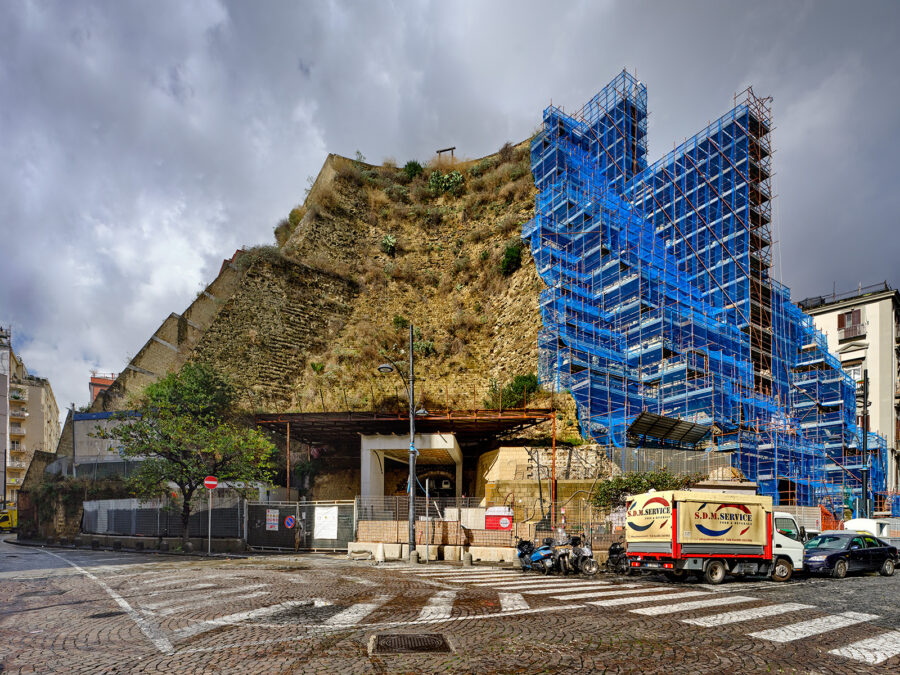
Palepolis (Pizzofalcone)
Napoli
2023
archival print/dibond/white frame
47.2-66.9 inches, (edition 5 + 2 a.p.)
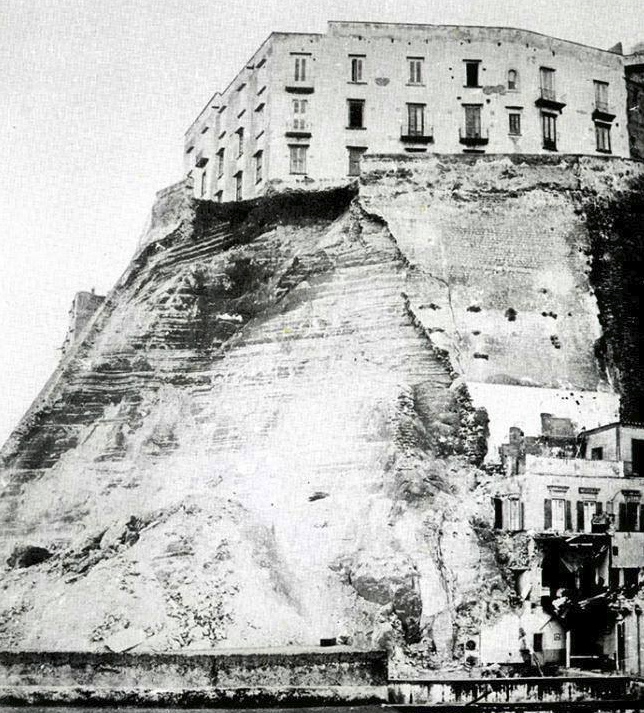
On Monte Echia, also known as Pizzofalcone, the earliest nucleus of Naples took shape. It was here that Greek settlers from Cumae founded the settlement of Parthenope in the eighth or seventh century BCE. The position on a tuff cliff above the bay offered natural protection and a commanding view of the coast. When Neapolis was established in the fifth century BCE, urban life gradually shifted eastward and Parthenope lost its central function.
In the Roman period the hill became part of the villa complex of Lucius Licinius Lucullus, an extensive residence with terraces, gardens and waterworks. Archaeological remains of walls and cisterns on Monte Echia are still attributed to this villa. After the fall of the Western Roman Empire the hill was used as agricultural land, and in the early Middle Ages Byzantine monks settled on the plateau.
Under the Spanish viceroys Pizzofalcone regained strategic significance. A military barracks was constructed on the summit to control access to the harbour and the growing urban area. In the nineteenth century the Bourbon rulers began work on the Galleria Borbonica, a tunnel intended to link the royal palace to the military quarters. The tunnel was never completed, and after an earthquake in 1862 part of the hill subsided due to a tuff embankment weakened by heavy rainfall.
In recent years Monte Echia has again drawn attention through the construction of a modern panoramic lift connecting the summit with the Santa Lucia district. The lift is intended to improve access to the archaeological plateau, enhance visibility of the Greek and Roman remains and integrate the hill into the coastal walking routes. The project is presented as a way to make heritage more accessible, yet it also raises questions about its impact on the landscape and the fragile historical layers of the site.